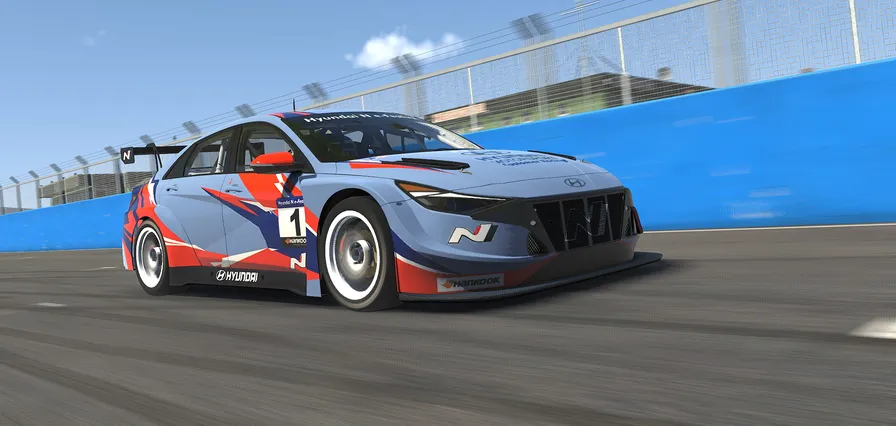
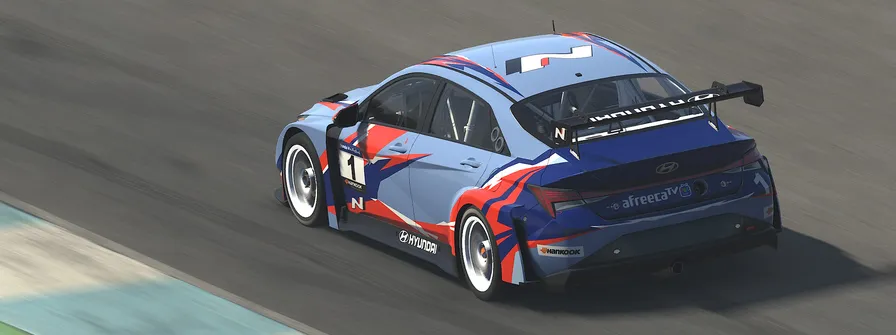
Hyundai Elantra N TCR
用户手册Hyundai Elantra N TCR
User Manual
亲爱的 iRacing 用户:
恭喜您购买 Hyundai Elantra N TCR!iRacing 全体成员感谢您的支持以及对我们产品的认可。我们致力于提供极致的模拟赛车体验,也希望您驾驶新车时能在赛道上尽享激情!
房车赛一直是全球最受欢迎的公路赛事形式之一,将易于上手的前轮驱动车辆与世界上众多传奇赛道相结合。由此呈现出的激烈贴身对抗,不仅让车手在驾驶席中乐在其中,也令看台上的车迷大呼过瘾。
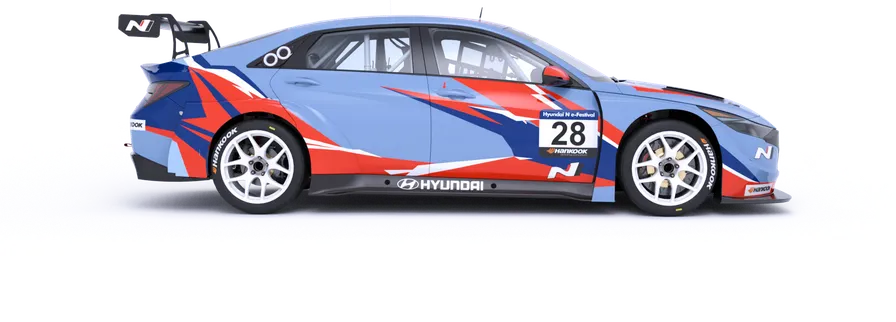
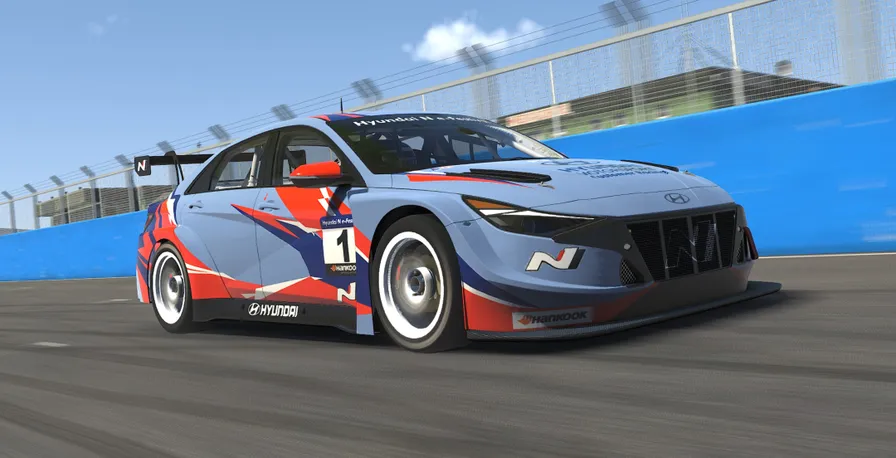
Hyundai Elantra N TC 于 2020 年 9 月发布,成为现代汽车面向全球客户车队推出的最新房车赛车。它接替此前赛季亮相的 i30 与 Veloster 房车,并在现代现有技术基础上进一步提升,搭载全新 2.0 升涡轮增压发动机,可输出 350 马力。该车于 2021 年首次参加 IMSA Michelin Pilot Challenge,由 Bryan Herta Autosport 派出两辆赛车参赛。
再次感谢您的购买,我们赛道上见!
DEAR iRACING USER,
Congratulations on your purchase of the Hyundai Elantra N TCR! From all of us at iRacing, we appreciate your support and your commitment to our product. We aim to deliver the ultimate sim racing experience, and we hope that you’ll find plenty of excitement with us behind the wheel of your new car!
Touring car racing remains one of the world’s most popular forms of road racing, combining approachable front-wheel drive cars with some of the most legendary circuits on the planet. The result is an aggressive, elbows-out form of road racing that proves to be just as much fun for the drivers behind the wheel as it is to watch for the fans in the seats.
Introduced in September 2020, Hyundai’s Elantra N TC became its latest touring car offering to customer teams around the world. Succeeding the i30 and Veloster touring cars that had made their debuts in previous seasons, the Elantra improves upon Hyundai’s existing technology with a brand new two-liter, turbocharged engine that produces 350 horsepower. The car made its IMSA Michelin Pilot Challenge debut in 2021, with Bryan Herta Autosport campaigning two cars.
Thanks again for your purchase, and we’ll see you on the track!
技术规格TECH SPECS
底盘CHASSIS
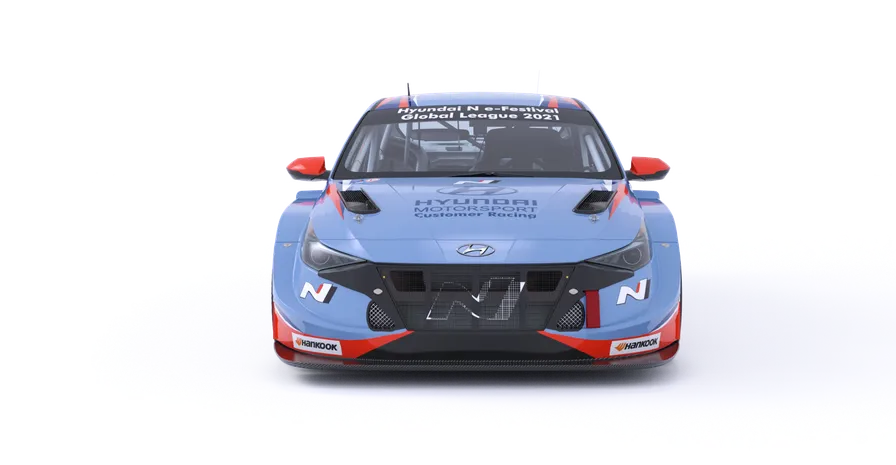
前置发动机、前轮驱动;前悬架采用麦弗逊支柱结构,后悬架采用多连杆结构
| 规格 | 数值 |
|---|---|
| 车长 | 4,710 mm / 185 in |
| 车宽 | 1,950 mm / 77 in |
| 轴距 | 2,750 mm / 108 in |
| 干重 | 1434 kg / 3162 lbs |
| 含车手湿重(含油液) | 1506 kg / 3320 lbs |
FRONT-ENGINE, FRONT-WHEEL DRIVE WITH FRONT MCPHERSON STRUT & REAR MULTILINK SUSPENSION
| Specification | Value |
|---|---|
| Length | 4,710mm / 185in |
| Width | 1,950mm / 77in |
| Wheelbase | 2,750mm / 108in |
| Dry Weight | 1434kg / 3162lbs |
| Wet Weight with Driver (Including Fluids) | 1506kg / 3320lbs |
动力单元POWER UNIT
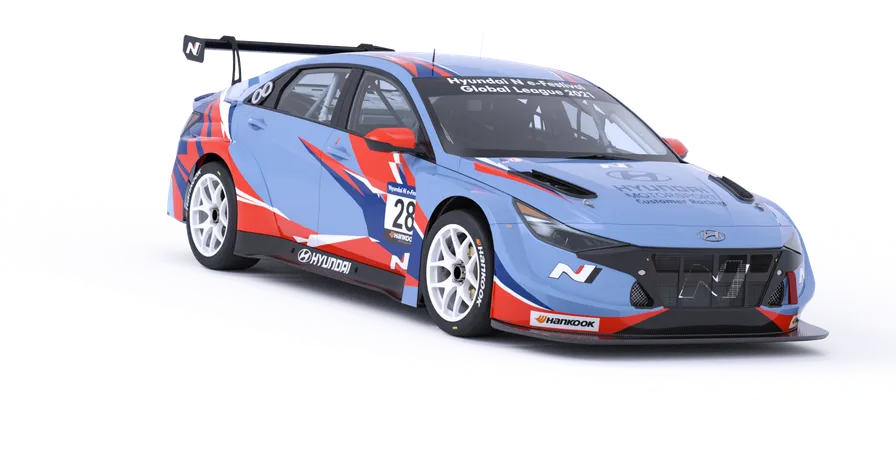
涡轮增压 DOHC 四缸发动机
| 规格 | 数值 |
|---|---|
| 排量 | 2.0 升 / 122 CID |
| 转速上限 | 7000 RPM |
| 扭矩 | 330 lb-ft / 450 Nm |
| 功率 | 350 bhp / 260 kW |
TURBOCHARGED DOHC 4-CYLINDER
| Specification | Value |
|---|---|
| Displacement | 2.0 Liters / 122CID |
| RPM Limit | 7000RPM |
| Torque | 330lb-ft / 450Nm |
| Power | 350bhp / 260kW |
简介INTRODUCTION
本指南旨在帮助您深入理解车库中可用的底盘设置选项,以便按照个人偏好调校车辆。
The information found in this guide is intended to provide a deeper understanding of the chassis setup adjustments available in the garage, so that you may use the garage to tune the chassis setup to your preference.
快速上手GETTING STARTED
启动车辆前,建议先为制动力分配调整映射控制按键。虽然这并非必要操作,但可让您在赛道上根据驾驶风格快速调整制动力分配。
进入车辆后,踩下离合器并挂入 1 挡。踩下油门的同时缓慢松开离合器,即可起步。
Hyundai Elantra N TC 配有六个前进挡和一个倒挡;车辆开始行驶后,升挡和降挡均无须使用离合器。停车时需要踩下离合器以防发动机熄火,必要时挂入倒挡也需要操作离合器。升挡时,只需按下已分配的按钮选择高一挡;降挡时,按下降挡按钮选择低一挡。
Before starting the car, it is recommended to map controls for Brake Bias adjustment. While this is not mandatory, this will allow you to make quick changes to the brake bias to suit your driving style while on track.
Once you load into the car, depress the clutch and select 1st gear. Slowly release the clutch while applying the throttle to drive away.
The Hyundai Elantra N TC features six forward gears and one reverse gear, and does not require clutch use once the vehicle is in motion for upshifts or downshifts. A clutch is necessary when coming to a stop to prevent stalling the engine and shifting into reverse if necessary. To upshift, simply press the assigned button to select the next higher gear. To downshift, press the downshift button to select the next lower gear.
载入 iRacing 设置LOADING AN iRACING SETUP
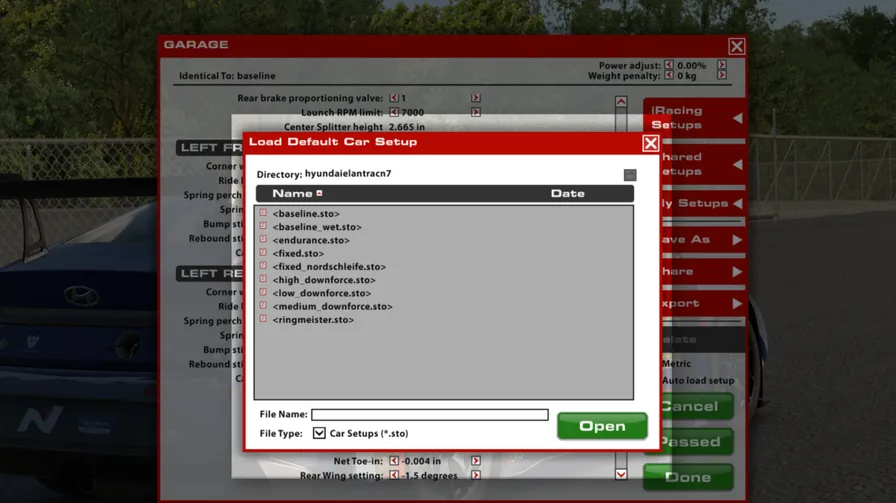
进入比赛会话后,车辆会自动载入 iRacing 基准设置 <baseline.sto>。如果您希望使用 iRacing 针对不同条件预制的其他设置,可以依次单击“车库 > iRacing 设置 >”,再选择符合需求的设置。
如需自定义设置,只需在车库中完成所需修改,然后单击“应用”。若要保存设置供日后使用,请单击右侧的“另存为”,为修改后的设置命名并保存。要查看所有个人设置,请单击车库右侧的“我的设置”。
如需与另一位车手或会话中的所有人共享设置,可以单击车库右侧的“共享”。
如果其他车手正在与您共享设置,也可以在车库右侧的“共享设置”中找到该设置。
Upon loading into a session, the car will automatically load the iRacing Baseline setup <baseline.sto>. If you would prefer one of iRacing’s pre-built setups that suit various conditions, you may load it by clicking Garage > iRacing Setups > and then selecting the setup to suit your needs.
If you would like to customize the setup, simply make the changes in the garage that you would like to update and click apply. If you would like to save your setup for future use click “Save As” on the right to name and save the changes. To access all of your personally saved setups, click “My Setups” on the right side of the garage.
If you would like to share a setup with another driver or everyone in a session, you can select “Share” on the right side of the garage to do so.
If a driver is trying to share a setup with you, you will find it under “Shared Setups” on the right side of the garage as well.
仪表页面DASH PAGES
Hyundai Elantra N TC 配备数字仪表显示屏,共有三个主要页面。页面会根据车辆当前状态自动切换,以便随时显示最相关的数据。
The Hyundai Elantra N TC features a digital dash display with three main pages. Pages change automatically based on what the car is doing to display the most relevant data at any given time.
页面 1PAGE 1
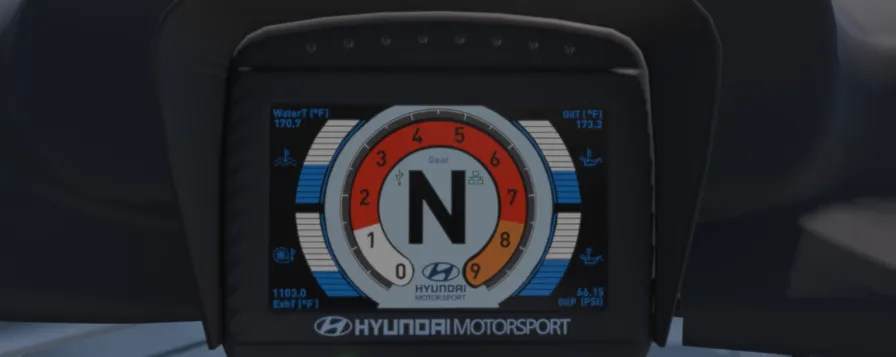
车辆静止且处于空挡时,启用第一个显示页面。
| 显示项目 | 说明 |
|---|---|
| Gear Indicator | 屏幕中央显示当前选择的挡位(此页面为空挡)。 |
| Tachometer | 挡位指示周围为显示发动机转速的转速表。 |
| Water Temp | 屏幕左上方显示发动机冷却液温度。 |
| Oil Temp | 屏幕右上方显示发动机机油温度。 |
| Exhaust Gas Temp | 屏幕左下方显示发动机排气温度。 |
| Oil Pressure | 屏幕右下方显示发动机机油压力。 |
The first display page is active when the car is stationary and in Neutral.
| Display | Description |
|---|---|
| Gear Indicator | The center of the display shows the selected gear (Neutral, for this page). |
| Tachometer | Surrounding the gear indicator is a tachometer displaying engine RPM. |
| Water Temp | The upper left of the display shows the Engine’s Water Temperature |
| Oil Temp | The upper right of the display shows the Engine’s Oil Temperature |
| Exhaust Gas Temp | The lower left of the display shows the engine’s Exhaust Gas Temperature. |
| Oil Pressure | The lower right of the display shows the Engine Oil Pressure. |
页面 2PAGE 2
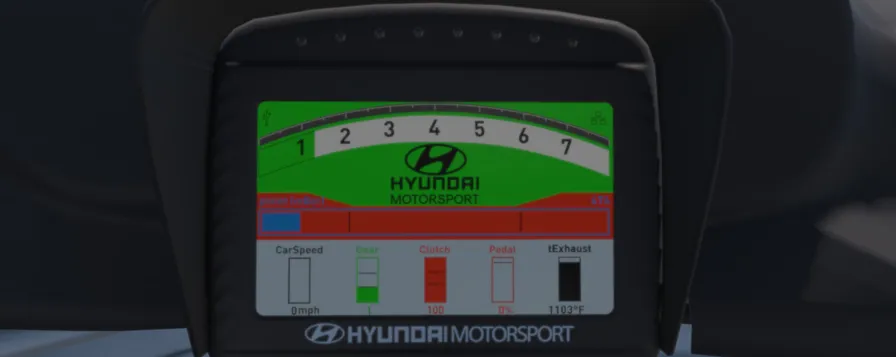
车辆静止但已挂入 1 挡时,启用第二个显示页面。该页面有助于完成静止发车。
| 显示项目 | 说明 |
|---|---|
| Tachometer | 屏幕上部显示发动机转速。 |
| pinlet (mBar) | 屏幕中央显示当前发动机进气压力。发车前提高转速时,进气压力达到最佳起步范围后,该条会变为绿色。 |
| CarSpeed | 左下方黑色条显示车辆速度。 |
| Gear | 绿色条显示当前选择的挡位。 |
| Clutch | 中央红色条显示当前离合器踏板位置。 |
| Pedal | 第二个红色条显示当前油门踏板位置。 |
| tExhaust | 右下方黑色条显示排气温度。 |
The second display page activates when the car is stationary but 1st gear is selected. This page is helpful for standing starts.
| Display | Description |
|---|---|
| Tachometer | The upper part of the display shows the engine RPM. |
| pinlet (mBar) | The center of the display shows the current engine inlet pressure. As RPM is increased for a start, this bar will change to green when inlet pressure is optimum for a launch. |
| CarSpeed | The black bar in the lower left shows the vehicle’s speed. |
| Gear | The green bar shows the currently selected gear. |
| Clutch | The red bar in the center displays the current clutch pedal position. |
| Pedal | The second red bar displays the current throttle pedal position. |
| tExhaust | The black bar in the lower right displays the Exhaust Gas Temperature. |
页面 3PAGE 3
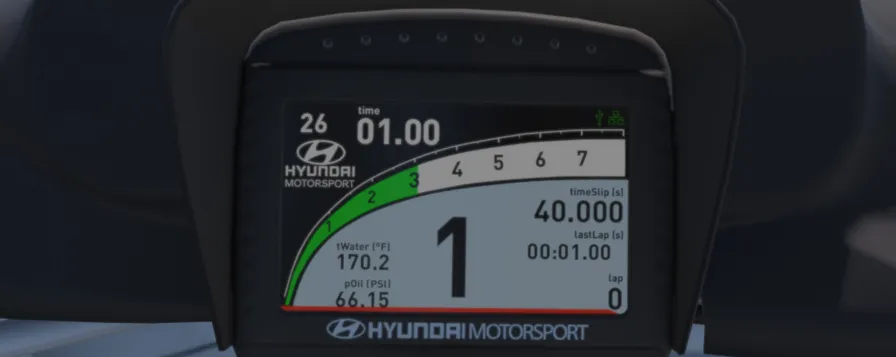
车辆开始行驶后,仪表会切换至第三个页面。该页面显示比赛所需信息,也是驾驶过程中最常用的页面。
| 显示项目 | 说明 |
|---|---|
| Speed | 当前车速,显示于 Hyundai Motorsport 标志上方的左上角。 |
| Time | 当前圈已经过的时间 |
| Tachometer | 屏幕上部显示发动机转速。 |
| tWater | 发动机冷却液温度,显示于下部区域左上方。 |
| pOil | 发动机机油压力,显示于左下方冷却液温度之下。 |
| Gear | 当前选择的挡位,显示于屏幕中央。 |
| timeSlip | 当前圈与本次会话最佳圈之间的圈速差。 |
| lastLap | 上一完整圈的圈速。 |
| Lap | 本次会话已完成的圈数,显示于右下方。返回维修区道路时,该数值不会重置。 |
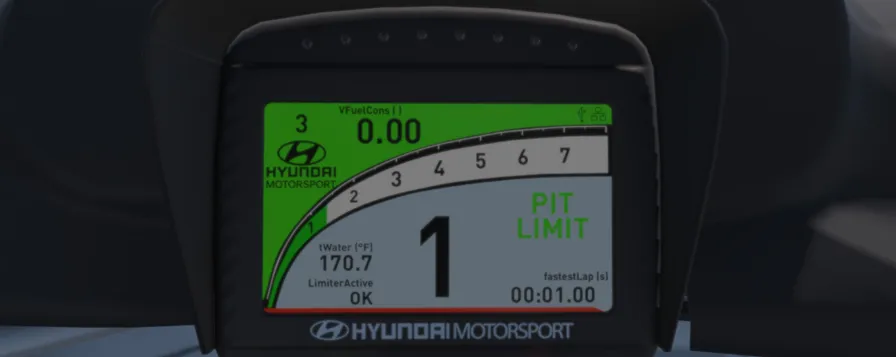
启用维修区限速器后,页面 3 的背景会由黑色变为绿色,以提示维修区限速器正在工作。
Once the vehicle is moving, the dash will change to the third page. This page displays information relevant for racing, and is the most
| Display | Description |
|---|---|
| Speed | Current vehicle speed is shown in the upper left above the Hyundai Motorsport logo. |
| Time | Time elapsed on the current lap |
| Tachometer | The upper part of the display shows the engine RPM. |
| tWater | Engine Water Temperature is shown on the upper left of the lower section. |
| pOil | Engine Oil Pressure is shown in the lower left, below Water Temperature. |
| Gear | The currently selected gear is shown in the center of the display |
| timeSlip | This shows the difference between the current lap and the session’s best lap |
| lastLap | The lap time for the previously completed lap is shown here. |
| Lap | The number of laps completed in the current session is shown in the lower right. This value does not reset when returning to pit road. |
When the pit limiter is active, Page #3 will change from black to green to show the Pit Speed Limiter is active.
高级设置选项ADVANCED SETUP OPTIONS
本节面向希望深入了解车辆各项设置的进阶用户。调整以下参数并非必要操作,而且可能显著改变车辆的操控特性。建议所有调整都采用小幅渐进的方式,每次仅更改一个变量,然后上赛道测试效果。
This section is aimed toward more advanced users who want to dive deeper into the different aspects of the vehicle’s setup. Making adjustments to the following parameters is not required and can lead to significant changes in the way a vehicle handles. It is recommended that any adjustments are made in an incremental fashion and only singular variables are adjusted before testing changes.
轮胎TIRES
轮胎设置TIRE SETTINGS
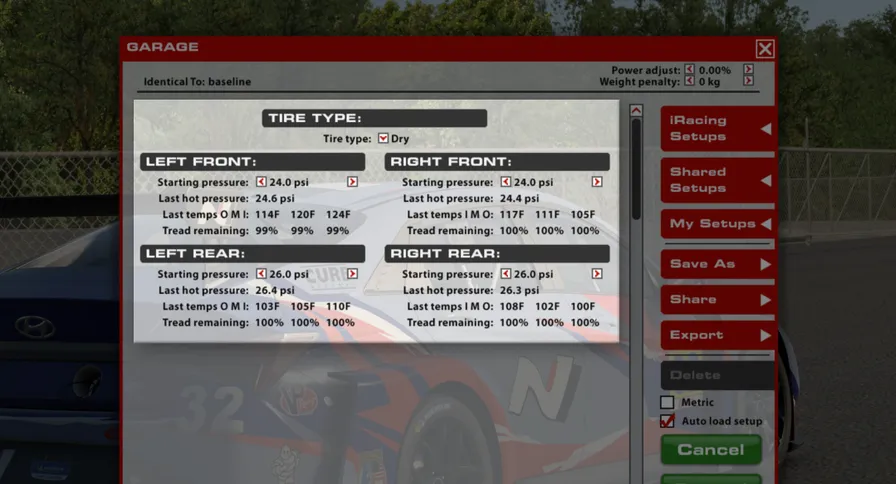
轮胎类型
选择车辆载入赛道时安装的轮胎类型。干地光头胎用于干燥比赛条件,湿地胎则用于降雨和湿滑赛道条件。
起始胎压
车辆载入赛道时的轮胎气压。较高胎压可降低滚动阻力和热量积聚,但会减少抓地力;较低胎压会增加滚动阻力和热量积聚,但可提高抓地力。车速和负荷较高时需要更高胎压,车速和负荷较低时则通常使用较低胎压表现更好。为获得最佳性能,应根据赛道特性设置冷态胎压。
上次热态胎压
车辆返回维修区后的轮胎气压。冷态与热态胎压之差可用于判断车辆在一个赛道驾驶阶段中的平衡变化;负荷较重的轮胎会产生更大的冷热胎压差。理想情况下,工作状态相近的轮胎应以相同速率增压,以免车辆的操控平衡随着轮胎使用时间而改变。因此,应调整冷态胎压,使同类轮胎达到工作温度后具有相近胎压。
轮胎温度
车辆返回维修区后,通过高温计测得的轮胎胎体温度。单轮载荷和轮胎在赛道上的工作强度会反映在胎温中,可利用这些数值分析车辆的操控平衡。中央温度适合直接比较各条轮胎的工作强度;内侧与外侧温度则可用于分析车辆在赛道上的车轮定位状态。这些数值分别在胎面上的三个区域测量。
剩余胎面厚度
车辆返回维修区后轮胎的剩余胎面厚度。轮胎磨损非常有助于识别车轮定位方面的潜在问题,例如轮胎一侧过度磨损;还可结合胎温分析车辆的操控平衡。这些数值分别在胎面上的三个区域测量。
TIRE TYPE
Selects which type of tire is installed on the car when loaded into the world. Dry, or slick, tires are used for dry racing conditions while Wet tires are intended for rain and wet track conditions.
STARTING PRESSURE
Air pressure in the tire when the car is loaded into the world. Higher pressures will reduce rolling drag and heat buildup, but will decrease grip. Lower pressures will increase rolling drag and heat buildup, but will increase grip. Higher speeds and loads will require higher pressures, while lower speeds and loads will see better performance from lower pressures. Cold pressures should be set to track characteristics for optimum performance.
LAST HOT PRESSURE
Air pressure in the tire after the car has returned to the pits. The difference between Cold and Hot pressures can be used to identify how the car is progressing through a run in terms of balance, with heavier-loaded tires seeing a larger difference between Cold and Hot pressures. Ideally, tires that are worked in a similar way should build pressure at the same rate to prevent a change in handling balance over the life of the tire, so Cold pressures should be adjusted to ensure that similar tires are at similar pressures once up to operating temperature.
TIRE TEMPERATURES
Tire carcass temperatures, measured via Pyrometer, once the car has returned from the pits. Wheel Loads and the amount of work a tire is doing on-track is reflected in the tire’s temperature, and these values can be used to analyze the car’s handling balance. Center temperatures are useful for directly comparing the work done by each tire, while the Inner and Outer temperatures are useful for analyzing the wheel alignment while on track. These values are measured in three zones across the tread of the tire.
TREAD REMAINING
The amount of tread remaining on the tire once the car has returned from the pits. Tire wear is very helpful in identifying any possible issues with alignment, such as one side of the tire wearing excessively, and can be used in conjunction with tire temperatures to analyze the car’s handling balance. These values are measured in three zones across the tread of the tire.
底盘CHASSIS
前部FRONT
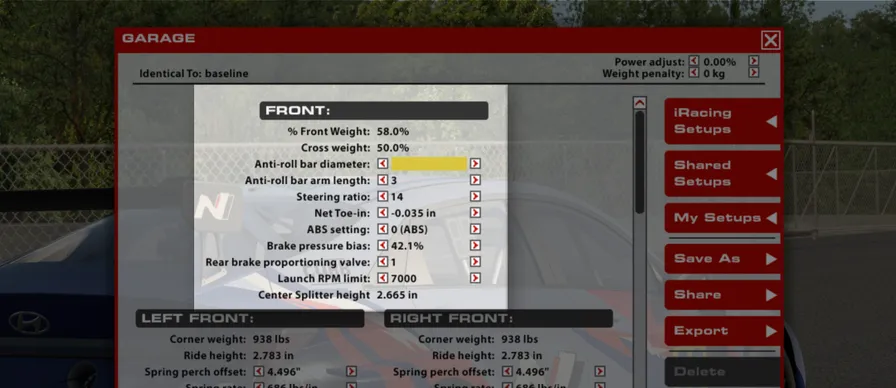
前轴配重百分比
车库中前轴载荷占车辆总重的百分比。较高的前轴配重会在过弯时增加转向不足并提高直线稳定性;较低的前轴配重则会在过弯时增加转向过度。该数值无法直接调整,而会随燃油量等其他设置变化。
对角配重
对角配重是左后轮与右前轮载荷之和占车辆总重的百分比。可通过各轮的弹簧座偏移在四个车轮之间转移载荷。最好将该数值保持在尽可能接近 50.0% 的位置,以确保左右弯中的操控特性对称。
防倾杆直径
防倾杆直径设置控制前悬架的侧倾刚度。直径更大的前防倾杆会提高侧倾刚度并增加转向不足;直径更小的防倾杆则会降低悬架侧倾刚度,从而减轻转向不足。
防倾杆臂长度
可通过调整防倾杆摆臂长度,在不改变防倾杆直径的情况下微调其等效刚度。较长的摆臂(数值较高)产生的等效刚度低于较短的摆臂(数值较低)。
转向传动比
转向传动比是方向盘转角与前轮转角之间关系的数值,可理解为让前轮转动 1° 所需的方向盘输入角度。例如,转向传动比“10”表示需要转动方向盘 10°,才能使前轮转动 1°。较低的转向传动比会让转向感觉更灵敏、更快,达到过弯所需轮胎转角时的方向盘输入也更少。换一种说法,在方向盘输入相同的情况下,较低的转向传动比会产生更大的前轮转角。Hyundai Elantra N TC 的真实赛车设置为 10;此外还提供 14,以使转向手感更接近本组别其他车辆。
总前束
从上方观察时,前束角是前轮相对于底盘中心线的夹角。该设置的正值表示正前束,负值表示负前束。车轮前缘比后缘更靠近中心线称为正前束,反之则称为负前束。在前轴增加负前束,会因转弯时内侧轮胎滑移角增大而降低直线稳定性。这有助于提高初始转向响应,但转向角过大时也更容易使轮胎滑移过度并失去抓地力。前轮正前束会降低初始转向响应,但可减少前胎温度积聚。
ABS 设置
防抱死制动系统(ABS)提供五个设置,以适应不同情况。设置 1 用于干地,设置 2 用于微湿条件,设置 3 用于湿地。设置 4 适合安全车阶段,设置 5 用于紧急情况,会使系统进入“跛行”模式。该数值可通过 F8 黑框调整。
制动力分配
制动力分配表示传递至前制动器的制动力百分比。数值高于 50% 时,更多制动力传递至前轮;低于 50% 时,更多制动力传递至后轮。应结合车手偏好和赛道条件进行调整,以获得当前情境下的最佳制动表现。
后制动比例阀
后制动比例阀设置控制传递至后轮的制动压力,可在不改变前轮制动压力的情况下调整后制动力。提高后制动比例阀数值会增加后轮制动管路压力,其效果类似于将制动力分配向后移动,但不会减少前轮制动力。降低后制动比例阀设置会减少后轮制动压力,效果类似于将制动力分配向前移动。
起步转速限制
静止发车时,可提高或降低转速限制器设置,以针对不同抓地力水平优化起步。较高的限制值可避免发动机转速跌落过多,但也更容易使前轮空转。
中央分流器高度
车库中会显示前分流器的离地间隙。该数值无法直接调整,但会随车库中的其他设置变化。技术检查不会对此数值进行限制,它仅用于参考车辆静止时的姿态。
% FRONT WEIGHT
The percentage of total vehicle weight in the garage across the front axle. Higher Nose Weight values will induce understeer when cornering and promote straight-line stability, while lower Nose Weight values will increase oversteer while cornering. This is not directly adjustable and is altered by other adjustments, such as Fuel Level.
CROSS WEIGHT
Cross weight is the amount of weight on the car’s Left-Rear and Right-Front tires relative to the entire weight of the car, displayed in percent. This is adjusted via the corner Spring Perch Offset settings to move weight between the four wheels. It’s best to keep this value as close to 50.0% as possible to ensure symmetrical handling characteristics.
ANTI-ROLL BAR DIAMETER
The Anti-Roll Bar Diameter setting controls the roll stiffness in the front suspension. Larger front Anti-Roll Bar sizes will increase roll stiffness and induce understeer, while smaller Anti-Roll Bar sizes can reduce understeer by softening the suspension’s roll stiffness.
ANTI-ROLL BAR ARM LENGTH
The length of the Anti-Roll Bar arms can be adjusted to fine tune the effective stiffness of the bar without changing the diameter. Longer arms (higher number values) will create a softer effective stiffness than shorter arms (lower number values).
STEERING RATIO
The Steering Ratio is a numerical value relating steering wheel angle to road wheel angle. This ratio can be thought of as the degrees of driver steering input needed to produce one degree of turn of the front wheels. For example, a steering ratio of “10” can be thought of as requiring 10° of steering input to turn the wheels 1°. A steering ratio with a lower ratio will feel more responsive or faster and will require less steering input to reach the tire angle needed to navigate a corner. Another way to think about this is that for the same steering wheel input, a lower steering ratio will produce more road wheel turn. The real-world setting for the Hyundai Elantra N TC is 10, however an option of 14 is available to make the steering feel more like what is found in the other vehicles in this class.
NET TOE-IN
Toe is the angle of the front wheels, when viewed from above, relative to the centerline of the chassis. Positive values for this setting are Toe-In, negative values are Toe-out. Toe-in is when the front of the wheels are closer to the centerline than the rear of the wheels, and Toe-out is the opposite. On the front end, adding toeout will decrease straight-line stability by increasing the slip angle on the inside tire when turning. This can aid in turn-in response but can make it easier to over-slip the tire and lose grip with too much steering angle. Toe-in at the front will reduce turn-in responsiveness but will reduce temperature buildup in the front tires.
ABS SETTING
The Anti-Lock Brake System (ABS) can be changed to one of five settings to suit different situations. Setting 1 is used for Dry conditions, Setting 2 is for Damp conditions, and Setting 3 is for Wet conditions. Setting 4 is useful for Safety Car situations and Setting 5 is for emergencies and puts the system into “Limp” mode. This value can be adjusted via the F8 Black Box.
BRAKE PRESSURE BIAS
Brake Bias is the percentage of braking force that is being sent to the front brakes. Values above 50% result in more pressure being sent to the front, while values less than 50% send more force to the rear. This should be tuned for both driver preference and track conditions to get the optimum braking performance for a given situation.
REAR BRAKE VALVE
The Rear Brake Valve setting controls the amount of braking pressure that goes to the rear wheels, allowing rear brake adjustment without altering the amount of pressure that goes to the front wheels. Increasing the Rear Brake Valve value will generate more brake line pressure to the rear wheels, producing a similar effect to reducing front brake bias, without reducing the braking force to the front wheels. Reducing the Rear Brake Valve setting will reduce brake pressure to the rear wheels, similar to shifting the brake bias forward.
LAUNCH RPM LIMIT
For standing starts, the RPM limiter can be adjusted up or down to optimize launch for different grip levels. Higher limits can prevent the engine from bogging down, but can spin the front tires more easily.
CENTER SPLITTER HEIGHT
The front splitter ground clearance is shown in the garage. This is not directly adjustable but will change based on other settings in the garage. There are no tech-inspection checks on this value and it only serves as a reference for the car’s attitude under static conditions.
前轮设置FRONT CORNERS
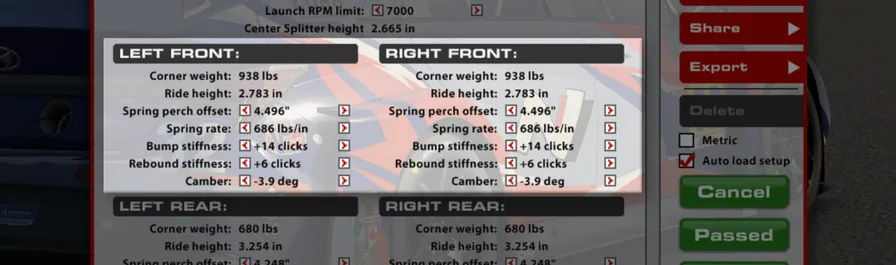
单轮载荷
车辆在车库中静止时,各车轮承受的载荷。合理分配各轮载荷,对于针对特定赛道和条件优化车辆至关重要。单轮载荷和对角配重均通过各轮的弹簧座偏移进行调整。
车高
地面到底盘参考点的距离。由于数值是相对于车辆上的特定参考点测量,因此未必代表车辆的实际离地间隙,但可作为车辆静止时距赛道表面高度的可靠基准。调整车高是获得最佳性能的关键,因为车高会直接影响车辆的空气动力学性能和机械抓地力。提高前车高会减少前轴下压力和整车总下压力,但会允许过弯时前轴发生更多横向载荷转移。相反,降低前车高会增加前轴及整车总下压力,但会减少前轴横向载荷转移。
弹簧座偏移
弹簧座偏移通过改变弹簧在静止状态下的预载来调整车高和单轮载荷。减小数值会提高弹簧预载,增加该轮载荷并抬高该轮车高;增大数值则作用相反,会降低该轮车高和载荷。调整车高时,应成对调整这些设置(例如左右轮同步调整),或同时调整车辆全部四个弹簧预载,以避免改变对角配重。
弹簧刚度
此设置决定各轮所安装弹簧的刚度。较硬的弹簧可缩小高、低负荷状态间的车高变化,并通过改善平台控制提高空气动力学性能;但也会加大轮胎负荷波动,导致机械抓地力下降。赛道越颠簸,硬弹簧的缺点通常越明显,此时使用较软弹簧反而能改善整体表现。各轮弹簧的变化会同时影响平台的侧倾和俯仰控制;调整各轮弹簧刚度时,还应考虑相应调整防倾杆,以保持原有的前后侧倾刚度分配和操控平衡。降低各轮弹簧刚度时,应提高防倾杆刚度,以维持更换弹簧前的整体侧倾刚度。更改弹簧刚度后,必须调整弹簧座偏移,将车辆恢复至此前的静态车高。
压缩刚度
压缩刚度影响减振器抵抗压缩(长度缩短)的程度,通常对应转向、制动、油门等车手操作及过弯力引起的底盘运动。较高的压缩刚度会减慢悬架行程并增加运动过程中的车轮负荷,但也会削弱悬架吸收颠簸的能力。降低压缩刚度有助于悬架吸收颠簸,但可能使车手感受到的底盘响应变弱。
回弹刚度
回弹刚度影响减振器抵抗伸长(长度增加)的程度,通常对应车手操作引起的车身运动。较高的回弹数值会减慢减振器伸长,较低的数值则允许其更快伸长。较高的回弹数值可以更好地控制空气动力学姿态,但如果悬架无法充分伸长并维持轮胎与赛道的正常接触,也可能导致车轮卸载。回弹过强还可能使车轮在赛道表面弹跳而无法持续贴地,引发不必要的振荡。
外倾角
外倾角是车轮相对于底盘中心的垂直夹角。车轮顶部比底部更靠近底盘中心线称为负外倾,轮胎顶部比底部更向外则称为正外倾。受悬架几何和过弯负荷影响,四个车轮通常都需要负外倾。增大负外倾角的绝对值可提高轮胎产生的横向力,但会降低制动时的纵向抓地力。外倾角过大虽然可能产生很强的过弯力,也会显著缩短轮胎寿命,因此需要在耐久性与性能之间取得平衡。增加前轮负外倾通常会增强中高速过弯时的前轴抓地力,但会损失制动性能,因此需要将制动力分配相应后移作为补偿。
CORNER WEIGHT
The weight underneath each tire under static conditions in the garage. Correct weight arrangement around the car is crucial for optimizing a car for a given track and conditions. Individual wheel weight adjustments and crossweight adjustments are made via the spring perch offset adjustments at each corner.
RIDE HEIGHT
Distance from ground to a reference point on the chassis. Since these values are measured to a specific reference point on the car, these values may not necessarily reflect the vehicle’s ground clearance, but instead provide a reliable value for the height of the car off of the race track at static values. Adjusting Ride Heights is key for optimum performance, as they can directly influence the vehicle’s aerodynamic performance as well as mechanical grip. Increasing front ride height will decrease front downforce as well as decrease overall downforce, but will allow for more weight transfer across the front axle when cornering. Conversely, reducing ride height will increase front and overall downforce, but reduce the weight transfer across the front axle.
SPRING PERCH OFFSET
Spring perch offset is used to adjust ride height and corner weight by changing the preload on the spring under static conditions. Decreasing the value increases preload on the spring, adding weight to its corner and increasing the ride height at that corner. Increasing the value does the opposite, reducing height and weight on a given corner. These should be adjusted in pairs (left and right together, for example) or with all four spring preload adjustments in the car to prevent crossweight changes while adjusting ride height.
SPRING RATE
This setting determines the installed corner spring stiffness. Stiffer springs will result in a smaller variance in ride height between high and low load cases and will produce superior aerodynamic performance through improved platform control; however, they will also result in increased tire load variation which will manifest as a loss in mechanical grip. The drawbacks of stiffer springs will become more pronounced on rougher tracks where softer springs will result in increased overall performance. Corner spring changes will influence both roll and pitch control of the platform and ARB changes should be considered when altering corner spring stiffnesses in order to retain the same front to rear roll stiffness and handling balance. When reducing corner spring stiffness the ARB stiffness should be increased to retain the same roll stiffness as before the spring change. Spring perch offsets must be adjusted to return the car to the prior static ride heights after any spring rate change.
BUMP STIFFNESS
Bump stiffness affects how resistant the shock is to compression (reduction in length), usually in chassis movements as a result of driver input (steering, braking, & throttle) and cornering forces. Higher Bump Stiffness values will slow suspension travel and increase wheel load during travel, but reduces how well the suspension can handle bumps. Reducing Bump Stiffness can help the suspension absorb bumps, but can reduce how responsive the chassis feels to the driver.
REBOUND STIFFNESS
Rebound stiffness affects how resistant the shock is to extension (increase in length), typically during body movement as a result of driver inputs. Higher rebound values will slow extension of the shock, lower values will allow the shock to extend faster. Higher rebound values can better control aerodynamic attitude but can result in the wheel being unloaded when the suspension can’t extend enough to maintain proper contact with the track. Excessive rebound can also lead to unwanted oscillations caused by the wheel bouncing off of the track surface instead of staying in contact.
CAMBER
Camber is the vertical angle of the wheel relative to the center of the chassis. Negative camber is when the top of the wheel is closer to the chassis centerline than the bottom of the wheel, positive camber is when the top of the tire is farther out than the bottom. Due to suspension geometry and corner loads, negative camber is desired on all four wheels. Higher negative camber values will increase the cornering force generated by the tire, but will reduce the amount of longitudinal grip the tire will have under braking. Excessive camber values can produce very high cornering forces but will also significantly reduce tire life, so it is important to find a balance between life and performance. Increasing front camber values will typically result in increased front axle grip during mid to high speed cornering but will result in a loss of braking performance and necessitate a rearward shift in brake bias to compensate.
后轮设置REAR CORNERS
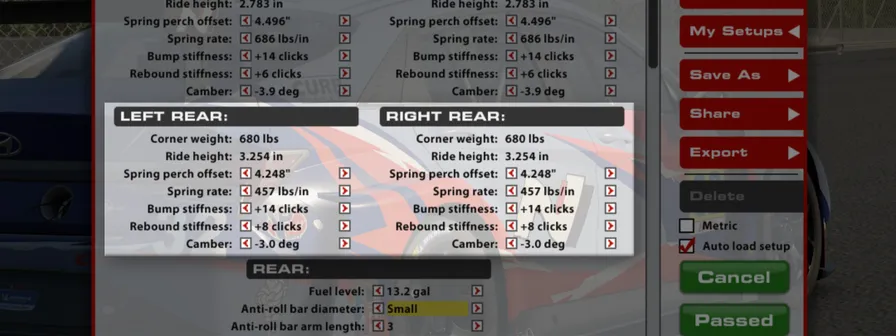
单轮载荷
显示车辆在车库中静止时各车轮承受的载荷,可用于在底盘调整过程中判断重量分布。
车高
地面到底盘后部参考点的距离。提高后车高会减少后轴下压力、增加整车总下压力,并允许过弯时后轴发生更多横向载荷转移。相反,降低后车高会增加后轴下压力占比、减少整车总下压力,同时降低后轴横向载荷转移。后车高是兼顾机械平衡与空气动力学平衡的关键调校项;为获得最佳表现,应根据所选后轮弹簧匹配静态后车高。
弹簧座偏移
弹簧座偏移通过改变弹簧在静止状态下的预载来调整车高和单轮载荷。减小数值会提高弹簧预载,增加该轮载荷并抬高该轮车高;增大数值则作用相反,会降低该轮车高和载荷。调整车高时,应成对调整这些设置(例如左右轮同步调整),或同时调整车辆全部四个弹簧预载,以避免改变对角配重。
弹簧刚度
与前轴相似,较硬的弹簧可缩小高、低负荷状态间的车高变化,通过改善平台控制提高空气动力学性能,但代价是机械抓地力降低。弹簧刚度应匹配赛道需求,并使车辆在高速与低速弯中的操控平衡保持一致。提高后弹簧刚度可使用较低的静态后车高,减少低速过弯时的后轴载荷转移;同时在高速过弯时维持甚至提高动态后车高,使空气动力学平衡前移并减轻转向不足。更改弹簧刚度后,必须调整弹簧座偏移,将车辆恢复至此前的静态车高。
压缩刚度
压缩刚度影响减振器抵抗压缩(长度缩短)的程度,通常对应转向、制动、油门等车手操作及过弯力引起的底盘运动。较高的压缩刚度会减慢悬架行程并增加运动过程中的车轮负荷,但也会削弱悬架吸收颠簸的能力。降低压缩刚度有助于悬架吸收颠簸,但可能使车手感受到的底盘响应变弱。
回弹刚度
回弹刚度影响减振器抵抗伸长(长度增加)的程度,通常对应车手操作引起的车身运动。较高的回弹数值会减慢减振器伸长,较低的数值则允许其更快伸长。较高的回弹数值可以更好地控制空气动力学姿态,但如果悬架无法充分伸长并维持轮胎与赛道的正常接触,也可能导致车轮卸载。回弹过强还可能使车轮在赛道表面弹跳而无法持续贴地,引发不必要的振荡。
外倾角
与前轮一样,为提高横向抓地能力,后轮也适合采用较大的负外倾角。由于后轮不是驱动轮,且通常承受的负荷小于前轮,因此后轮使用的负外倾角一般小于前轮。增大后轮负外倾角可提高轮胎的过弯力,但也会增加磨损和热量积聚,并降低轮胎的最大制动能力。
CORNER WEIGHT
This displays the weight on each wheel while sitting in the garage under static conditions. Useful for determining weight distribution during chassis adjustments.
RIDE HEIGHT
Distance from ground to a reference point on the rear of the chassis. Increasing rear ride height will decrease rear downforce but will increase overall downforce and will allow for more weight transfer across the rear axle when cornering. Conversely, reducing ride height will increase rear downforce percentage but reduce overall downforce while reducing the weight transfer across the rear axle. Rear ride height is a critical tuning component for both mechanical and aerodynamic balance, and static rear ride heights should be considered and matched to the chosen rear corner springs for optimal performance
SPRING PERCH OFFSET
Spring perch offset is used to adjust ride height and corner weight by changing the preload on the spring under static conditions. Decreasing the value increases preload on the spring, adding weight to its corner and increasing the ride height at that corner. Increasing the value does the opposite, reducing height and weight on a given corner. These should be adjusted in pairs (left and right together, for example) or with all four spring preload adjustments in the car to prevent crossweight changes while adjusting ride height.
SPRING RATE
Similar to the front axle, stiffer springs will result in a smaller variance in ride height between high and low loads and will produce better aerodynamic performance through improved platform control at the expense of mechanical grip. Spring stiffness should be matched to the needs of the racetrack and set such that the handling balance is consistent between high and low speed cornering. Increasing rear spring rate will allow for a lower static rear height which will reduce rear weight transfer during slow speed cornering while maintaining or even increasing the rear ride height in high speed cornering to shift the aerodynamic balance forwards and reduce understeer. Spring perch offsets must be adjusted to return the car to the prior static ride heights after any spring rate change.
BUMP STIFFNESS
Bump stiffness affects how resistant the shock is to compression (reduction in length), usually in chassis movements as a result of driver input (steering, braking, & throttle) and cornering forces. Higher Bump Stiffness values will slow suspension travel and increase wheel load during travel, but reduces how well the suspension can handle bumps. Reducing Bump Stiffness can help the suspension absorb bumps, but can reduce how responsive the chassis feels to the driver.
REBOUND STIFFNESS
Rebound stiffness affects how resistant the shock is to extension (increase in length), typically during body movement as a result of driver inputs. Higher rebound values will slow extension of the shock, lower values will allow the shock to extend faster. Higher rebound values can better control aerodynamic attitude but can result in the wheel being unloaded when the suspension can’t extend enough to maintain proper contact with the track. Excessive rebound can also lead to unwanted oscillations caused by the wheel bouncing off of the track surface instead of staying in contact.
CAMBER
As with the front of the car it is desirable to run significant amounts of negative camber in order to increase the lateral grip capability. Since the rear wheels are not driven and are typically under less load than the fronts, the rear tires will usually see better performance with less camber than the front tires. More rear camber will increase cornering forces from the tires as increasing wear and heat buildup, but will decrease maximum braking capacity from the tires.
后部REAR
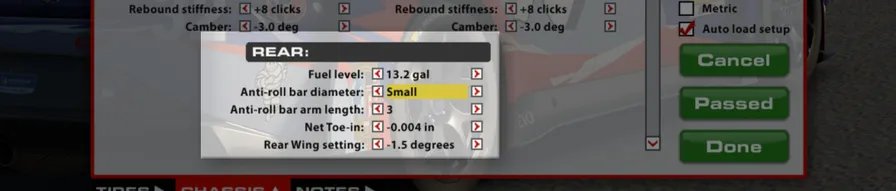
燃油量
燃油量是车辆驶离车库时油箱内的燃油量。
防倾杆直径
防倾杆直径设置控制后悬架的侧倾刚度。直径更大的后防倾杆会提高侧倾刚度并增加转向过度;直径更小的防倾杆则会降低悬架侧倾刚度,从而减轻转向过度。
防倾杆臂长度
可通过调整防倾杆摆臂长度,在不改变防倾杆直径的情况下微调其等效刚度。较长的摆臂(数值较高)产生的等效刚度低于较短的摆臂(数值较低)。
总前束
从上方观察时,前束角是后轮相对于底盘中心线的夹角。该设置的正值表示正前束,负值表示负前束。车轮前缘比后缘更靠近中心线称为正前束,反之则称为负前束。在后轴增加负前束会降低直线稳定性,并可能在某些情况下突然引发转向过度。后轮正前束会降低初始转向响应,但会提高直线稳定性。
尾翼设置
可通过尾翼设置改变尾翼攻角。较高角度会使尾翼产生更多下压力,使空气动力学平衡向后移动,从而增加中高速弯中的转向不足,但也会增加阻力。较低角度会减少下压力,使空气动力学平衡前移,从而增加中高速弯中的转向过度,同时也会减少尾翼产生的阻力。可用角度范围为 -4.0° 至 +4.0°;但需要注意,所有角度都会产生下压力,负角度并不会产生升力。
FUEL LEVEL
Fuel level is the amount of fuel in the fuel tank when the car leaves the garage.
ANTI-ROLL BAR DIAMETER
The Anti-Roll Bar Diameter setting controls the roll stiffness in the rear suspension. Larger rear Anti-Roll Bar sizes will increase roll stiffness and induce oversteer, while smaller Anti-Roll Bar sizes can reduce oversteer by softening the suspension’s roll stiffness.
ANTI-ROLL BAR ARM LENGTH
The length of the Anti-Roll Bar arms can be adjusted to fine tune the effective stiffness of the bar without changing the diameter. Longer arms (higher number values) will create a softer effective stiffness than shorter arms (lower number values).
NET TOE-IN
Toe is the angle of the rear wheels, when viewed from above, relative to the centerline of the chassis. Positive values for this setting are Toe-In, negative values are Toe-out. Toe-in is when the front of the wheels are closer to the centerline than the rear of the wheels, and Toe-out is the opposite. On the rear end, adding toe-out will decrease straight-line stability and can induce oversteer suddenly in some cases. Toe-in at the rear will reduce turn-in responsiveness but will increase straight-line stability.
REAR WING SETTING
The rear wing’s angle of attack can be changed via the Rear Wing Setting. Higher angles will cause the wing to produce more downforce and shift aero balance rearward, inducing understeer in mid- to high-speed corners, but will increase drag. Lower angles will reduce the amount of downforce generated and shift aero balance forward, increasing oversteer in mid- and high-speed corners, but will also reduce the amount of drag produced by the wing. Angle settings are available from -4.0° to +4.0°, however it is important to note that all angles will produce downforce, and negative angles do not produce lift.
调校提示SETUP TIPS
本节旨在帮助希望深入了解车辆各项设置的用户。
This section is aimed toward helping users who want to dive deeper into the different aspects of the vehicle’s setup.
调校提示SETUP TIPS
“iRacing 设置”文件夹中提供以下设置:
基准 — 50 L 燃油,操控特性较为保守,适合首次驾驶本车。
湿地基准 — 50 L 燃油,针对湿地天气调整设置并安装湿地胎。
固定设置 — 25 L 燃油,适用于 15 分钟官方固定设置冲刺系列赛。
纽北固定设置 — 38 L 燃油,适用于纽博格林较长距离的固定设置比赛。
中等下压力 — 45 L 燃油,适用于半小时官方系列赛,下压力水平可应对多种赛道。
低下压力 — 45 L 燃油,适用于半小时官方系列赛,下压力水平适合代托纳或勒芒等重视降低阻力的赛道。
高下压力 — 45 L 燃油,适用于半小时官方系列赛,下压力水平适合狭窄、多弯且偏好高下压力(以及可能较少车身旋转)的赛道。
耐力 — 满箱燃油,中等下压力配置,适用于长距离耐力赛。
The following iRacing setups are provided in the iRacing setups folder:
Baseline - 50L fuel with conservative handling characteristics for your first time in the car.
Baseline Wet - 50L fuel with setup adjustments and wet tires fitted for wet weather conditions.
Fixed - 25L fuel for the 15 minute official fixed sprint series.
Fixed Nordschleife - 38L fuel for the longer fixed race at Nürburgring.
Medium Downforce - 45L fuel for the half hour official series with downforce levels appropriate for a variety of tracks.
Low Downforce - 45L fuel for the half hour official series with downforce levels appropriate for tracks like Daytona or Le Mans where minimizing drag is important.
High Downforce - 45L fuel for the half hour official series with downforce levels appropriate for tighter, twisty tracks where high levels of downforce (and possibly less rotation) is preferred.
Endurance - Full fuel for long endurance races with a medium downforce trim.
制动系统设置BRAKE SYSTEM SETTINGS
本车配有制动力分配调节器,用于改变前后制动管路之间的压力平衡。
Hyundai Elantra N TCR 还配有后制动压力限制器(比例阀)。在给定踏板力下,它会减少传递至后制动器的压力,但不会影响前制动管路压力;重刹时,它还允许有效制动力分配(前制动管路压力百分比)向前移动。前轮驱动车辆的后胎静态载荷较小,重刹时后胎负荷会进一步减轻。正确调整比例阀可以避免后胎在这种情况下抱死。
较高的比例阀设置允许更高的后制动管路压力和制动力,但也存在后轮抱死的风险。比例阀每从最大值下调一挡,有效前制动管路压力占比约增加 1%。最低的比例阀设置对后制动管路压力限制最强,这会迫使前制动器承担最多工作,并延长制动距离。
应先设置制动力分配调节器,针对低、中等踏板力工况进行调校;再设置比例阀,用它微调大踏板力下的制动表现。
- 较低制动阀设置 = 重刹时有效制动力分配更靠前。
- 较高制动阀设置 = 重刹时有效制动力分配更靠后。
This car has a Brake Bias Adjuster to change the pressure balance between the front and rear brake lines.
The Hyundai Elantra N TCR also has a Rear Brake Pressure Limiter (Proportioning Valve), which reduces the amount of pressure going to the rear brakes (it has no effect on front line pressure) for a given pedal force input. It also allows the effective brake bias (% Front line pressure) to move forward in heavy braking conditions. Since front wheel drive cars do not have much static load on the rear tires, hard braking can result in lightly-loaded rear tires. A properly adjusted Proportioning Valve can keep the rear tires from locking in these situations.
Higher Prop Valve settings allow more rear brake line pressure and stopping power but risk locking the rear brakes. Each Prop Valve adjustment down from the maximum increases the effective % Front line pressure by about 1%. The lowest Prop Valve setting limits rear brake line pressure the most, this forces the front brakes to do the most work and will increase stopping distances.
Set your Brake Bias Adjuster first and tune it for low and medium pedal force situations, then set the Proportioning Valve next as a way to fine-tune high pedal force braking.
- Lower Brake Valve Setting = Higher effective brake bias during heavy brake situations.
- Higher Brake Valve Setting = Lower effective brake bias during heavy brake situations.
空气动力学调整AERODYNAMIC ADJUSTMENTS
改变操控特性最简单的方法是调整尾翼设置。尾翼角度越高(越偏正值),空气动力学平衡越向后移动(车辆越趋向转向不足),阻力也越大。如果不确定某条赛道适合的尾翼配置,可先从 -2 开始,再根据需要调整为更多车身旋转(减少尾翼)或更少车身旋转(增加尾翼)。
- 尾翼更高(更偏正值)= 车身旋转更少/下压力和阻力更大
- 尾翼更低(更偏负值)= 车身旋转更多/下压力和阻力更小
如果希望在不改变下压力配置(尾翼设置)的情况下调整空气动力学平衡,可通过各轮的弹簧座调整改变车辆前后车高差。增大前后车高差(后部更高、前部更低)会使空气动力学平衡前移,增加车身旋转;减小前后车高差(后部更低、前部更高)会使空气动力学平衡后移,减少车身旋转。需要注意,保持较低的前分流器高度对于产生下压力和提高空气动力学效率非常重要。除极端情况外,建议调整前后车高差时保持最低前车高,仅调整后车高。
The easiest way to make changes to the handling is to adjust the rear wing setting. A higher angle (more positive) wing setting is a more rearward aero balance (understeer) as well as more drag. A wing setting of -2 is a reasonable place to start if you are unsure of a reasonable wing trim for any given track. You may find you want more rotation (less wing) or less rotation (more wing) from there.
- Higher Wing (More Positive) = Less Rotation / More Downforce and Drag
- Lower Wing (More Negative) = More Rotation / Less Downforce and Drag
If you find you wish to change the aero balance of the car without changing your downforce trim (wing setting), you can adjust the rake of the vehicle with the spring perch adjustments on each corner of the car. More rake (higher rear, lower front) will move aero balance forward (more rotation) and less rake (lower rear, higher front) will more aero balance rearward (less rotation). It is worth noting that keeping the splitter (front) height low is important for making downforce and aero efficiency. It is recommended that when adjusting rake you adjust rear heights while keeping front heights at minimum for all but the most extreme of situations.
底盘调整CHASSIS ADJUSTMENTS
还可通过选择前后弹簧来影响动态空气动力学平衡。前部或后部使用较软弹簧,会在负荷下产生更大压缩量,使车辆该端下沉得更多(动态车高更低);较硬弹簧则会在相同负荷下更好地支撑车辆该端。利用这些调整,可以改变车辆在赛道行驶时的动态前后车高差。
- 前后车高差更大(后部相对前部更高)= 车身旋转更多
- 前后车高差更小(后部相对前部更低)= 车身旋转更少
如果希望在不改变空气动力学平衡的情况下调整机械平衡,可调整前后防倾杆及防倾杆摆臂。
更大的前防倾杆/更短的防倾杆摆臂 = 车身旋转更少
更小的前防倾杆/更长的防倾杆摆臂 = 车身旋转更多
更大的后防倾杆/更短的防倾杆摆臂 = 车身旋转更多
更小的后防倾杆/更长的防倾杆摆臂 = 车身旋转更少
It is also possible to affect the dynamic aero balance with front and rear spring selection. A softer spring at front or rear will allow more deflection under load which will let that end of the car travel more (lower ride heights) while a stiffer spring will hold up that end of the car more under the same load. You can affect the rake of the car while on track with these adjustments.
- More Rake (Higher Rear vs Front) = More Rotation
- Less Rake (Lower Rear vs Front) = Less Rotation
If you would like to change the mechanical balance without changing the aero balance the front and rear ARBs and ARB arms may be adjusted.
Bigger Front ARB/Shorter ARB Arms = Less rotation
Smaller Front ARB/Longer ARB Arms = More rotation
Bigger Rear ARB/Shorter ARB Arms = More rotation
Smaller Rear ARB/Longer ARB Arms = Less rotation
后轮定位REAR ALIGNMENT
对这辆前轮驱动车辆,预计可使用一定程度的后轮负前束,以增加车身旋转和出弯驱动力。负前束越大(数值越负),车辆在入弯和弯中的旋转越明显。较小的负前束(数值更偏正)可能更符合您的驾驶风格,也可能让车辆在当前驾驶方式、设置或赛道条件下保持更一致的旋转特性。建议对此进行尝试——这是一项效果非常显著的调整!
It is expected you may wish to run some amount of rear toe out to increase rotation and drive off in this front wheel drive car. More toe out (negative) will result in more rotation on entry and mid corner. You may find less toe out (more positive) may suit your driving style or keep rotation more consistent for your driving, setup, or track conditions. Some experimentation is encouraged here! This can be a powerful adjustment!